
新闻编辑室
China-US basketball exchange brings young players together on and off court_我的网站

一 |
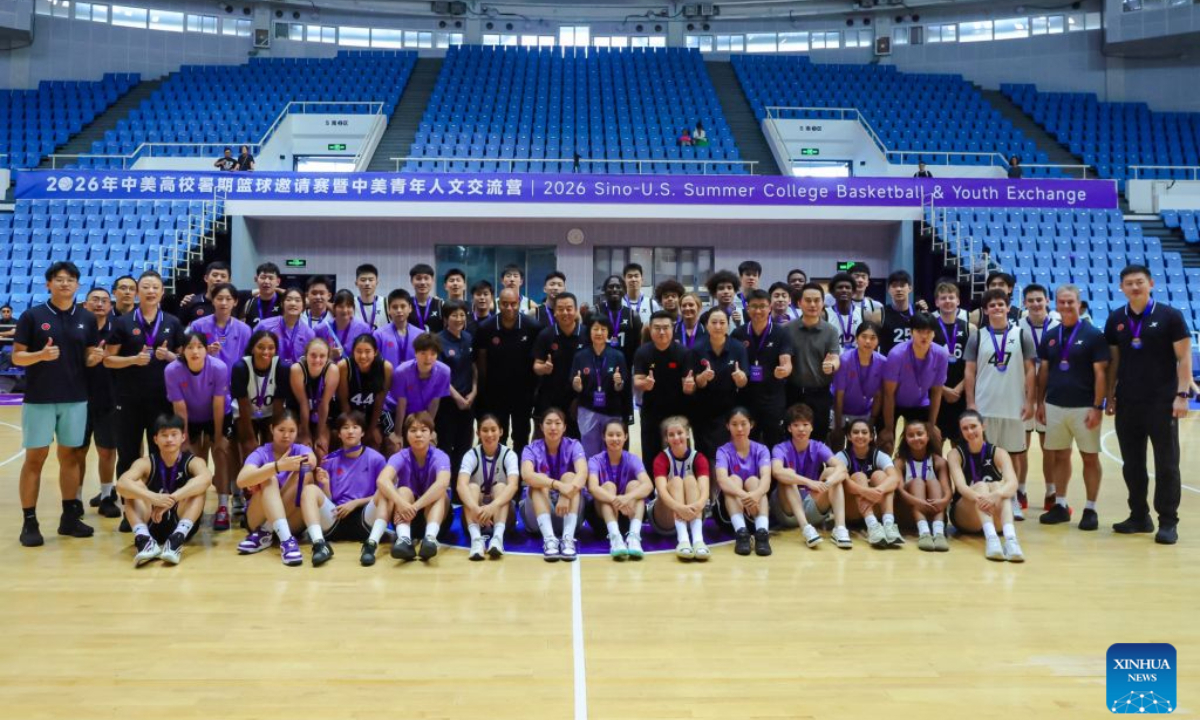
On the basketball court, young players from the two countries came together as teammates, rather than competitors.
The basketball games, held at Tsinghua University's sports complex in Beijing over the weekend, featured 16 U.S. players teaming up with their Chinese peers in separate men's and women's games, with players from both countries mixed on each team.
The games were a highlight of the 2026 Sino-U.S. Summer College Basketball & Youth Exchange, a six-day program that brought together U.S. students from universities including Stanford University, Harvard University and Yale University.
Co-hosted by China Center for International People-to-People Exchange (CCIPE) under the Ministry of Education and Tsinghua University, the program combines basketball competitions with activities including campus tours and cultural experiences to deepen exchanges, cultivate sportsmanship, and promote communication, understanding, friendship, and cooperation among younger generations on both sides.
"I'm so excited," said Lily Brown, a 20-year-old student from Bates College, after her team won. "Everyone had really good hustle, and everyone was attacking the basket really well and shooting with confidence."
After training with her Chinese teammates for several days, Brown said that despite the language barrier, they shared much in common, from movies and entertainment to social media.
"We communicate through basketball," she added.
That shared language is at the heart of the program's mixed-team format, according to J.R. Carnegie-Hargreaves, the U.S. delegation's team leader.
"The shared pursuit of basketball creates a common ground, and from that, mutual trust and friendship take root," he said.
The idea of using sports to bring people together has a long history in China-U.S. relations. In 1971, a U.S. table tennis team made a historic trip to China, marking the reopening of channels for friendly people-to-people exchanges between the two countries.
This April, Chinese and American young people gathered for events marking the 55th anniversary of Ping-Pong Diplomacy.
Today, young people are increasingly seen as vital bridges in bilateral relations. Deputy Director-General of the CCIPE Cao Diefeng said at the opening ceremony that the program was designed to help young people from both countries not only get to know each other on the court but also step into each other's thoughts and daily lives.
"Through firsthand experiences of the development story, cultural heritage and social landscape of each other's countries, they may come to see each other in a truer, fuller and more vivid light," he added.
China launched an initiative in November 2023 to invite 50,000 young Americans to visit the country for exchange and educational programs over five years. According to China's Ministry of Foreign Affairs, more than 50,000 young Americans have since visited China, reaching the target two and a half years ahead of schedule.
For many young Americans, the chance to explore China is an experience in itself. Jason Singleton, an 18-year-old student from Harvard University, said that he felt "blessed" to join the exchange program. It was his first trip to China after studying Chinese for about six years.
"Not everybody in America gets the chance to see the Great Wall," he said, delighted to get immersed in the Chinese culture during the journey.
For Cuyler Sparks, a high school student at Choate Rosemary Hall, the chance to learn more about Chinese basketball while exploring the country was one she couldn't "say no" to.
On her first trip to China, time spent with her Chinese teammates has been just as memorable, especially trying local foods. Roast duck quickly became her favorite dish.
"We don't know what some of the things are, so they explain to us how to eat them and what's really good," she said. "Just being together and trying to figure things out, even with the language barrier, has been really fun."
For some participants, the exchange was more than just a first encounter; it was a chance to continue a friendship that had already begun.
Xi Taicheng, a senior student from Tsinghua University who joined the event two years ago, was glad to meet some familiar faces again this time.
"Playing alongside the U.S. players was always a refreshing experience," he said. During several days of joint training, they chatted about their studies, training and the Chinese Basketball Association (CBA), with the Americans curious about life and basketball in China.
"I've made more new friends this time and added almost all the players on the U.S. men's team on social media," Xi said. "It's been really fun chatting and spending time together."
。 Six days after a brutal attack by armed Hamas militants on Israeli civilians, Israel ordered an evacuation of more than 1 million Palestinians in northern Gaza ahead of what could be an unprecedented ground offensive there against Hamas."We are going to destroy Hamas infrastructures, Hamas headquarters, Hamas military," vowed Israeli Defense Minister Yoav Gallant as airstrikes were underway.The U.S. and other nations have repeatedly warned Israel to follow the "rules of war."But what are they? And will they prevent civilians from being hurt?Here's what to know about international humanitarian laws and how they might apply in the Israeli-Hamas conflict in Gaza.
Is Israel bound by the rules of war?
Yes.Israel has promised to abide by international humanitarian law including those under the Geneva Convention that seeks to minimize the impact on civilians, provide aid to the wounded on the battlefield, and not to mistreat prisoners of war.In general, the U.S. military and Israeli Defense Force also rely on similar rules of engagement in military operations.Israel insists it follows the rules of war and always has.But there is disagreement by international groups about exactly what qualifies as a violation in a country's quest to defend itself against terror attacks, as well as whether Israel could be prosecuted through the International Criminal Court -- an entity Israel doesn't recognize.Officials at the United Nations and European Union have accused Israel of already violating its promise not to harm civilians by cutting water and electricity to all of Gaza residents, including to hospitals. They also say it's impossible to ensure the safety of so many civilians by giving only 24 hours to evacuate to avoid the fighting.Palestinian health authorities estimate 1,799 civilians have been killed in Israeli airstrikes, including 583 children, following Hamas' attacks that have killed at least 1,300 Israelis.Ravina Shamdasani, spokesperson for the Office of the U.N. High Commissioner for Human rights, said Hamas' brutality doesn't "liberate" Israel from adhering to international humanitarian laws."It is absolutely crucial that Israeli leaders and global leaders make it unambiguously clear that international humanitarian law is an obligation. It is not optional, and that military operations must be conducted in full compliance with international law," she said.President Joe Biden said he delivered that message directly to Israeli Prime Minister Benjamin Netanyahu this week, later telling reporters "that it is really important that Israel, with all the anger and frustration … they operate by the rules of war.""And there are rules of war," Biden added.How would the rules apply in this conflict? Would civilians be spared?
Avoiding harm to civilians though can fall into a gray area, particularly when it comes to a massive ground operation unfolding on a remarkably narrow strip of land. Gaza is among the most populated areas on Earth, roughly 7.5 miles at its widest and 25 miles long with some 2 million inhabitants.Eric Oehlerich, a retired Navy SEAL and ABC News contributor, said that even with sophisticated weaponry, such an operation would be extraordinarily difficult to carry out with no civilians harmed."There isn't a force in the world that can deal with 40,000 (enemy) soldiers interspersed with civilians in that densely populated area" and have "zero" civilian deaths, said Oehlerich."It's impossible," he added.One question will be what constitutes a valid military target, said Mick Mulroy, a former deputy assistant secretary of defense for the Middle East and retired CIA paramilitary operations officer.Israel says that Hamas -- which doesn't abide by humanitarian laws in its deliberate attack on civilians last week -- uses Palestinian civilians and hospitals as shields."If Hamas holds up in a building -- whether it's a hospital or mosque -- it becomes a valid military target," said Mulroy, also an ABC contributor. "That said, every reasonable step should be taken to eliminate or reduce civilian casualties (and) has to be done."What does all this mean for hostages held by Hamas and US citizens inside Gaza?
Oehlerich, who has participated in military operations to free hostages, said getting those hostages out using military force will also be extraordinarily tough. That's because Hamas will likely have gone to great lengths to hide the hostages, including possibly rigging secret tunnels or even the hostages themselves with explosives.Oehlerich said success is more likely to come through backchannel negotiations with countries like Egypt and Qatar.Israeli officials say its special operations forces have been operating inside Gaza in past days trying to locate hostages. The US is also working the Red Cross and the UN to establish "safe zones" for foreign nationals to leave, including Americans located within Palestine, according to a senior State Department official.Beyond that, questions remain on how many innocent people will be hurt or killed inside Gaza. When asked by a reporter Friday what worries him most about the Israeli ground invasion, Biden had a one-word answer."Death," he said.ABC News' Shannon Crawford, William Gretsky and Mary Bruce contributed to this report.。Current article:http://5hv.tuncuansazhuandengqiaofen.bond/list_c26/m0v5qei.html
Published on:06:36:34
最新文章
- 第五人格IVL:ACT战队不鸣则已一鸣惊人,惊艳四座豪取冠军!
- 杭州给新就业青年的“见面礼”:公寓前三晚免费
- Karan Johar Thanks Shah Rukh Khan for His Heartfelt Praise for Homebound
- 新三板基础层公司斯特龙大宗交易溢价5.26%,成交金额57.37万元
- 粤港举行研讨活动 聚焦打造湾区游艇生活圈
- 戏曲为媒 七夕有约 《中华有好戏》七夕特别节目浪漫启幕
- Suifenhe vehicle exports to Russia more than double
- 这场国家级数字出版博览会,为何值得奔赴?
- 特斯拉计划2023年将柏林工厂周产量提升至5000辆
- 什么是“老庄股”,为何要回避?| 1211 张博划重点
标签云
热门文章
- 研究发现即使是少量的运动也能极大地增加大脑的体积
- Swati granted bail in controversial tweets case
- 涉嫌非国家工作人员受贿罪,金融圈金领卷入刑案,所在投行经营连年暴跌
- 政声直达丨116个科技小院助力乡村全面振兴
- 《GTA6》母公司T2发力了!誓死要抓住葱哥 绳之以法
- 国产GPU四小龙之一燧原科技 申购时间定了
- 今晚对阵深圳 国安要用胜利为第一阶段收官
- 数据中心关停?FSD入华无望?特斯拉中国辟谣:正常运转 辅助驾驶招聘工作在加速进行
- 初耕杏坛向未来育桃李 沐光而行促成长谱华章——北京教育学院2024年新任教师培训“顺义小语班”集体研修活动在西辛小学教育集团举行
- 厦门市五缘实验幼儿园2025年幼儿寒假体育锻炼计划